Crunchy Con strikes again! (228)

Check out the very very very long post  (and the many many many comments) on Rod Dreher’s Crunchy Con  site on gay marriage, traditionalism, and deep moral disagreement.

I refrained from commenting—but do add a comment, if you so desire. Please note, however, that it may take awhile for your comment to appear, so wait a bit before re-posting the same comment.

Posted in Pol 228 Democracy and Its Critics | Tagged , , | Leave a comment

No sentences, just bits (266)

On an ongoing New York City program to decrease violence in teen relationships.

Follow-up to Brazilian abortion story.

More drugs and violence in Mexico.

L’etat, c’est moi in Libya.

No more school for girls in the Swat region of Pakistan (video).

Good music goes out of tune in Palestine and Israel.

Life and death and AIDS in South Africa and Lesotho.

Justice in Cambodia for Khmer Rouge leader?

More than one type of violence in Gaza.

To be on t.v. in Afghanistan is to court death.

And for your visual enjoyment (but no naked hikers).

Posted in Pol 266 Politics and Culture | Tagged , , , , , , , , | Leave a comment

Deliberative dishonesty (228)

More bashing Gutmann & Thompson questions and comments on the readings:

on William Galston:

*p. 41, and violation of parents’ integrity: Perhaps, if consider only parents’ integrity. What of children’s integrity? Isn’t the issue that the parents and the children may be at odds—and that acting as if were at odds leads to a taking of sides such that pull children on to school board’s side, against the parents? That is, that this is a matter of at least partial irreconcilability among the players, and thus only coercion can resolve issue, coercion which either protects parents’ integrity at expense of children’s, or vice versa?

*p. 44, on the difficulty of providing evidence that accommodating the dissenting parents would impede the development of civic values in the children:  Not really all that tough, if accept propositional arguments as evidence, eg, We live in a pluralist society, which means that citizens hold many different beliefs. Furthermore, all citizens are equal, and have equal right to hold those beliefs. As such, while you may not share those different beliefs, and while you may not want everyone to have a right to hold their beliefs, as long as you live in this society, it is not unreasonable to expect that you learn how to live amongst your fellow citizens—just as your fellow citizens must learn how to live with you. This does not require acceptance of beliefs you find repugnant; it merely requires that you recognize the fact of those other beliefs, and behave accordingly.
Now, were the board to require a kind of maximal behavior, they could legit be said to impermissibly impinge upon the integrity of the fundam parents, but as a minimum—merely learning about the existence and some basic facts about those different beliefs—it is a reasonable impingement. In other words, recognize the coercion involved, and justify the legitimacy of that coercion.
The problem w/G&T’s formulation is that they’re unwilling to admit the presence—or, for that matter, the necessity—of coercion, which leaves them open to charges of manipulation.
What may be required, then, is a discussion of the role of coercion in a democratic polity.

*p. 45, and the need for society to accommodate diverse groups as much as possible: Hm. And claims of equality? What if these diverse ways of life impede the ability of members of those different ways from, in fact, choosing to diverge from the way chosen for them?

*p. 47, on the need for society to prioritize liberty: Yes, liberty—but whose? The liberty of the group or sect or even of parents, or of the individual, whether member or not, or child or not? This is a difficult issue, but Galston barely considers it, raising it only briefly in the notes (#8)

*p. 47, that G&T’s delib ought to include those who might reject its (current) terms: This is always a difficult matter: what should advocates of tolerates do w/advocates of intolerance? I think Galston slides away from this as a general matter, focusing instead on the willingness of some parents to compromise w/one middle school. What to do if unwilling to compromise? He criticizes the board for its inflexibility—and may have a point in such criticism, not least because the tolerant should be flexible–-but doesn’t even this formulation scant the deeper conundrum?

on Stanley Fish:

Okay, I have to warn y’all: I find Fish highly irritating, and liable to juke around an argument rather than confront its difficulties. That said, he often finds (real) difficulties which others overlook, which makes him an irritating author worth reading. Usually.

* p. 89, if state neutral among positions, all controversies flattened into either distractions or impossibilities,citz denied opportunity to improve themselves: Ouch. But it does get at a certain tone in G&T, doesn’t it?

*p. 95, and the line ‘Mutual respect’ should be named ‘mutual self-congratulation, since it will not be extended beyond the circle of those who already feel comfortable w/one another.’— Always? That G&T have a problem w/fundam religious believers hardly means the phrase does no real work whatsoever. This is Fish’s pique getting in the way of his own reasoning.

*p. 95,    -G&T draw norms from academy & pol sci depts [HAH!]: ‘It is not accurate to characterize these men and women as ‘morally committed, for what they are committed to is not their morality but the deliberative process to whcih their morality is delivered up on the way, perhaps, to being abandoned. What they are committed to is the deferring of commitment in favor of an every attenuated ‘conversation’ whose maintenance is the only value they wholeheartedly embrace.’ —
Now Fish is engaging in the kind of argumentation of which he accuses G&T. Given that he’s not a pol sci prof, I question his version of what happens in pol sci departmental meetings as lacking in anything other than supposition. More to the point, he seeks to dismiss a particular point of view which he finds disreputable by cloaking that dismissal in a cloud of airy everybody-knows-this conclusion. So it’s only bad when others do this, Mr. Fish?

Okay, so I’ve finished Fish, and, in many ways I agree with him. Man: in many ways I agree with him.

I hate that.

Posted in Pol 228 Democracy and Its Critics | Tagged , , , , , | Leave a comment

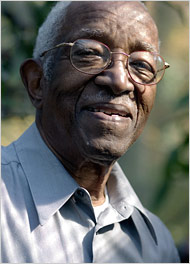
A giant loss, the loss of a giant

John Hope Franklin, one of the United States’ greatest historians, died today.

January 2, 1915-March 25, 2009

January 2, 1915-March 25, 2009

Photo by Derek Anderson for the New York Times

Read his obituary in the New York Times, as well as his website at Duke University.

Click on ‘Quotations’ on the Duke site to get a glimpse of how this man’s mind worked. One of my favorites:

“I have never regretted the decision to remain a student and a teacher of history. …I have been a student and advocate of the view that the exchange of ideas is more healthy and constructive than the exchange of bullets.”
Charles Homer Haskins lecture
April 14, 1988

Rest in peace, Professor Franklin.

Posted in All courses | Tagged , , , , , | Leave a comment

Why this and not that? (228)

That was, in essence, Shemori’s question: Why is it okay to sell sperm and eggs and not solid organs?

It’s a good question.

I think the response I offered—that these have been two separate narratives, shaped by particular events—is a reasonable one, but it speaks more to the history of the trajectories than their current, and apparently similar, location on the political and bioethical landscape.

So I turn Shemori’s question back to you, with a few emendations: Why is it okay to sell sperm and eggs and not solid organs? Are the two situations really all that similar, or is there something fundamentally different about the cases? Does it matter that gametes (sperm and egg) are a ‘renewable’ resource and organs are not? Should it matter?

Does it matter that the market in gametes involve issues of infertility—and not, as in organ transplantation, life and death?

Should these two situations continue along their separate political and ethical trajectories, or should those lines merge? And if they do merge, how should they do so? Should a market for organs be developed? Should the market in sperm and eggs be shut down? What of regulation?

Gutmann and Thompson deliberate over surrogacy; ought these matters be subject to deliberation? And if so, how should or would or could (these are three separate questions, with likely three different responses) such deliberation take place? How much education should take place within or prior to deliberation? What of the role of experts? What of the roles of those most affected by the issues? What of the general, concerned, citizen?

Some of you were wondering about the next paper, and what you could or ought to write on. Perhaps you could take some of these questions, or consider a similar set of issues (‘why this and not that’) and ask the appropriate questions.

In any case, thanks, Shemori, for asking a really good question.

Posted in Pol 228 Democracy and Its Critics | Tagged , , , , , | Leave a comment

Enough already! (228)

Some thoughts while preparing notes on G&T’s chapter 7 (on liberty):

*I wonder if G&T don’t unnecessarily lard down their theory, that it would in fact work better if it weren’t more open, closer to anything goes. One could hang on to reciprocity, accountability, and publicity, and, perhaps, toss the rest—or at least allow questions of liberty and opportunity to be subject to deliberation itself. In other words, make sure that everyone gets to take part, no one gets to kick anyone else out, and let those in the deliberation determine their own rules, rules which may violate G&T’s content principles, but work nonetheless for that group.

*It makes sense that G&T refer to real life cases and the legally relevant conditions—in the Stern/Whitehead case, that of the enforcement of contracts—but they seem unnecessarily tied to what is legally relevant. Yes, they do go beyond legality into moral considerations, but why not question the contract model itself? Couldn’t that be a consideration for deliberation? Classical Liberals (i.e., capitalists) may accept the inviolability of the contract and the liberty which inheres in the contract, but neither of these presumptions is incontestable. A radical, for example, may simply point to the practicality of contracts without granting their enforcement any particular moral claims.

*G&T have mentioned that evidence must inform all deliberation, such that the arguments be truly reasoned. That said, their move at this point [p. 245] seems to include ‘majority’ evidence and exclude ‘minority’ evidence. Perhaps in law-making it makes sense to rely upon majority evidence, but it’s not at all clear that deliberation itself should not also consider the minority evidence. So most woman who have served as surrogates are happy they did so—that ought to matter. But shouldn’t it also matter that some regret this decision? Maybe there isn’t any way to craft a law which takes both perspectives into account, but why not at least consider a way to deal with the latter case?

*G& T offer an incredibly weak response [p. 246] to the fact of class differences between surrogates & recipients. Again, this classical-Liberal response downgrades the significance of class differences, noting that because not all lower classes would participate in a particular activity, this must mean that such participation must be free. Apparently, anything which is not directly coerced is free; this seems a weak defense of the liberty—and integrity—of all, including members of the lower classes.
Furthermore, they seem to elide the differences which they highlighted earlier between the labor of pregnancy and that of other forms of labor. This might explain how they overlook considerations of the integrity of those in all areas who labor out of financial need.

*Re: the faulty bridge scenario [p. 264]. Is the issue that no real infringement of liberty, or that no real paternalism: The officer has more information and, in a direct and immediate emergency, acts on it. The paternalism might consist of continued detention if person nonetheless insists on crossing, but that’s a separate matter.

This whole chapter raises a question some in Macedo’s book have raised: Why bother w/actual deliberation, when G&T can set in motion a ‘thought-piece’ deliberation which leads to (their preferred) deliberatively-appropriate solution? They seem to have already concluded the right response to surrogacy, and simply reverse-engineered deliberation to lead to that outcome. Giancarlo’s suspicions seem borne out in full in this chapter.

So back to my first point: why so damned many conditions [on content]? Why not simply rely upon the principles which regulate the process (reciprocity, publicity, accountability) and let the deliberators hash out what conditions they would impose upon themselves?

I ask this as someone who dearly loves her Constitutional protections, i.e., that there are some claims on my behalf which I don’t have to argue or convince anyone else to accept: I can simply assert those claims with reference to a relevant Constitutional article or amendment. In other words, I don’t have to justify my being.

Nonetheless, there is sufficient and nasty dispute over the interpretation of those Constitutional protections that I wonder if by putting those disputes outside of the arena of deliberation (through recourse to the content principles) , that they don’t undercut the real power of deliberation to enhance democracy.

Jefferson may or may not have been glib in stating that a little revolution or bloodshed every now and then is a good thing, but I think taking the metaphor seriously—i.e., that we have to rethink periodically our first principles in order to keep them fresh—would enhance democracy.

And if it would lead to a lessened democracy, well then, maybe that’s all we would deserve.

In somewhat related (to surrogacy, anyway) news:

William Saletan of Slate, who continues to drive me crazy, offers another real-life scenario in the world of assisted reproductive technologies: couples who choose to terminate a pregnancy in which the wrong embryo was implanted.

G&T might approve of his suggestion, but I remain skeptical—tho’ perhaps because I’m in a moment of general allergy to anything Saletan suggests. . . .

Posted in Pol 228 Democracy and Its Critics | Tagged , , , , , , , | Leave a comment

Condoms and whatnot (266)

The head of the Roman Catholic Church, Pope Benedict, on his first trip to Africa as pope, restated the Church’s position against the use of condoms to fight HIV and AIDS. While on a plane to Cameroon, he argued that abstinence was the most appropriate approach to fighting the spread of HIV. “You can’t resolve it with the distribution of condoms,” the pope told reporters aboard the plane heading to Yaoundé. “On the contrary, it increases the problem.”

The Centers for Disease Control holds a different view. Here’s a study from the Public Health Service, originally published in 1993, and a fact sheet on condom effectiveness distributed by the CDC.

For yet another view, on taking African voices into account when determining policies for Africans, see here.

Here’s the Guardian story on so-called ‘corrective rape’ I mentioned early. One survivor of an abduction and rape, Phumla, noted that

Every day you feel like its a time bomb waiting to go off. You don’t have freedom of movement, you don’t have space to do as you please. You are always scared and your life always feels restricted. As women and as lesbians we need to be very aware that it is a fact of life that we are always in danger.

Austrian Josef Fritzl, accused of the 24-year enslavement and repeated rape of his daughter and murder of one of his sons, changed his plea on the enslavement and murder charges from not guilty to guilty.

Mark Danner has a story in the New York Review of Books on the International Committee of the Red Cross’s investigation of torture at Guantanamo. ICRC reports are usually kept confidential; Danner got hold of a leaked copy.

New Zealand has decriminalized prostitution.

I hope the women use condoms. . . .

Posted in Pol 266 Politics and Culture | Tagged , , , , , , | Leave a comment

Naked hiker (with sweater!)(266)

As promised, a chicken in a cosy:

BBC

BBC

Gotta love the English. . . .

Posted in Pol 266 Politics and Culture | Tagged , , | Leave a comment

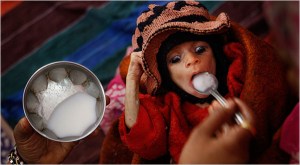
This is what hunger looks like (266)

From the New York Times:

In India, by contrast, despite robust growth and good government intentions, the comparable number [of children under the age of 5 who are underweight] is 42.5 percent.

Ruth Fremson/The New York Times

Ruth Fremson/The New York Times

Read the entire story, and watch the accompanying video slide show.

Posted in Pol 266 Politics and Culture | Tagged , , | Leave a comment

Naked hiker alert! (266)

Okay, I think I’ll end up posting pictures of critters whenever they make our ‘naked hiker’ story list.

Thus:

The 'sausage-dog horse', via BBC News online

The 'sausage-dog horse', via BBC News online

Yes, Mayflower was described as a ‘sausage-dog horse’ in the story.

Now, if only I could find that elephant-prosthesis photo. . . .

Posted in Pol 266 Politics and Culture | Tagged , , | Leave a comment